
 Book a call with us (30 Minute Meeting)




 Krishna Mishra
 22 October 2026
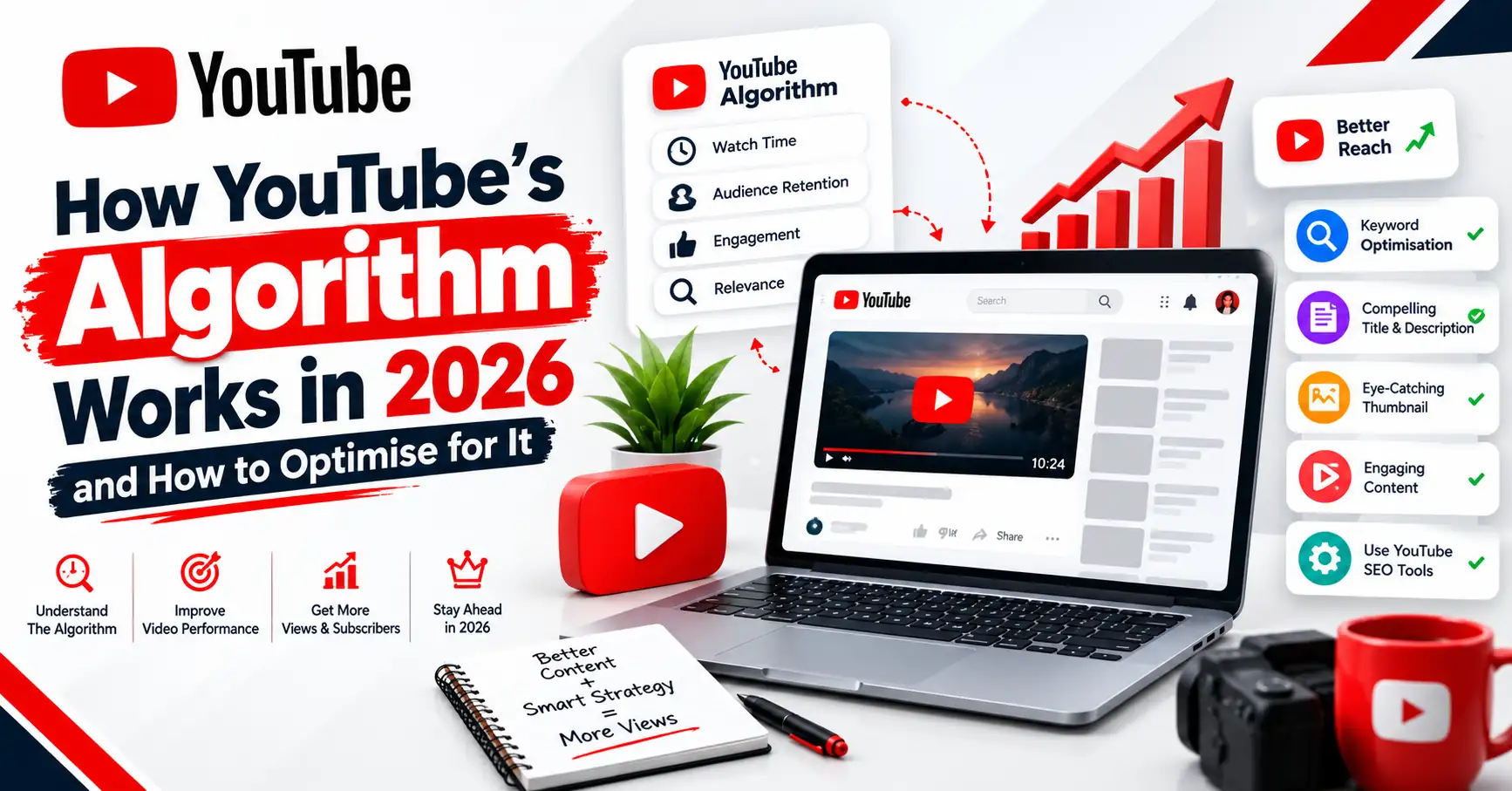
How YouTube’s Algorithm Works in 2026
Learn how YouTube’s algorithm works in 2026 and discover practical video optimisation tips to improve rankings, increase views, boost engagement, and grow your channel organically.
YouTube has become one of the most popular platforms for watching videos, learning new skills, and discovering content. However, creating a good video is only one part of growing a YouTube channel. To reach the right audience, creators need to understand how YouTube recommends videos and what makes viewers choose, watch, and enjoy their content.
In 2026, YouTube does not rely on a single algorithm to rank every video. Instead, it uses different recommendation and ranking systems across the Home page, Suggested Videos, YouTube Search, Shorts feed, and other sections. These systems consider several signals to predict which videos are most relevant and useful to individual viewers. The goal is to help people discover content they are likely to watch and enjoy.
YouTube No Longer Relies on One Single Algorithm
YouTube does not use one universal algorithm to rank every video. Instead, it uses different recommendation and discovery systems depending on where people watch content and what they are looking for.
For example, a person searching for a tutorial may see videos based on relevance and usefulness. Someone browsing the Home page may receive recommendations based on their viewing habits, interests, and previous interactions.
The main places where YouTube recommends videos include:
- Home page: Videos selected according to a viewer's interests and watch history.
- Suggested Videos: Recommendations based on the current video and the viewer's preferences.
- YouTube Search: Videos that best match a search query and satisfy the viewer's needs.
- Shorts feed: Short videos selected according to relevance, viewer behaviour, and engagement signals.
- Subscriptions: Recent uploads from channels a viewer has chosen to follow.
Each surface serves a different purpose. A video that performs well in YouTube Search may not receive the same level of exposure on the Home page.
How to optimise for different YouTube surfaces
Start by identifying the main purpose of your video. If you want to attract people searching for a specific solution, focus on YouTube SEO, clear titles, and helpful content. If your goal is to reach new viewers through recommendations, focus on an interesting opening, strong storytelling, and audience retention.
For Shorts, deliver the main idea quickly. For longer videos, organise the content into clear sections and give viewers a reason to keep watching.
Understanding these differences helps you build a more effective YouTube marketing strategy instead of relying on one approach for every video.
Viewer Satisfaction Has Become the Biggest Ranking Factor
Views alone do not tell YouTube whether a video is genuinely useful. A person might click on a video because the title looks interesting but leave after a few seconds because the content does not match their expectations.
YouTube considers several signals to understand whether viewers find a video satisfying. These can include watch behaviour, likes and dislikes, shares, feedback, survey responses, and whether people continue watching content on the platform.
No single signal guarantees higher rankings. The system uses a combination of information to predict which videos individual viewers are likely to enjoy.
For example, imagine two videos about digital marketing. The first has an attractive thumbnail but offers little useful information. The second has a clear title, practical examples, and advice that answers the viewer's questions.
The second video may provide a better viewing experience, even if the first video initially receives more clicks.
How to improve viewer satisfaction
Follow these practical steps:
- Deliver the information promised in your title.
- Avoid misleading thumbnails and exaggerated claims.
- Give viewers useful information instead of lengthy introductions.
- Use examples that make difficult topics easier to understand.
- Improve audio quality, video clarity, and overall presentation.
- Ask for feedback and use it to improve future videos.
For businesses, viewer satisfaction is especially important. A video should not only attract attention but also help potential customers understand a product, service, or problem.
When viewers find your content useful, you have a better chance of building trust and encouraging them to return.
Retention Still Plays a Major Role
Audience retention measures how long viewers continue watching a video. It helps you understand which parts of your content hold attention and where viewers tend to leave.
Watch time and retention remain important considerations for YouTube recommendations, but longer viewing time does not automatically mean a video will rank higher. The platform also considers the type of content and whether viewers are satisfied with what they watch.
For instance, a five-minute tutorial that answers a question clearly may be more valuable than a 20-minute video filled with unnecessary explanations.
Ways to improve audience retention
1. Start with a strong opening
The first few seconds should tell viewers what they will learn or gain. Avoid long introductions, unrelated stories, or lengthy logo animations before delivering value.
2. Remove unnecessary information
Every section should support the main topic. If a sentence, example, or clip does not help the viewer, consider removing it during editing.
3. Use a clear content structure
Break your video into logical sections. A good sequence helps viewers understand the topic and makes the content easier to follow.
4. Add relevant visual elements
Screenshots, demonstrations, animations, charts, and on-screen examples can make information easier to understand. Use them when they add value rather than simply to make the video look busy.
5. Study your retention graph
YouTube Studio provides audience retention data that can show where viewers lose interest, rewatch a section, or skip ahead. Use these patterns to identify what works and what needs improvement.
For example, if viewers regularly leave during a long introduction, shorten it in your next video. If they rewatch a demonstration, consider creating more content around that subject.
Click-Through Rate Still Matters
Click-through rate (CTR) measures the percentage of eligible thumbnail impressions that result in people clicking on your video.
A compelling title and thumbnail can encourage more people to watch your content. However, a high CTR does not automatically lead to wider distribution. YouTube also considers what happens after the click.
Imagine your video receives 10,000 thumbnail impressions and 500 people click on it. Your CTR would be 5%.
However, CTR varies depending on the traffic source, audience, and how widely a video is being recommended. There is no single percentage that guarantees success.
How to improve YouTube CTR
- Write clear, relevant titles. Tell viewers what the video offers. Use your main keyword naturally without making the title difficult to read.
- Design easy-to-understand thumbnails. Use a clear subject, good contrast, and a simple visual idea. Avoid overcrowding the thumbnail with too many elements.
- Create a connection between the title and thumbnail. The title can explain the topic while the thumbnail highlights the main benefit or creates curiosity.
- Avoid clickbait. Misleading titles may attract clicks initially, but they can disappoint viewers and damage trust.
- Review performance over time. Compare CTR across similar videos and traffic sources instead of judging every upload against one fixed benchmark.
For example, a video titled "How to Improve YouTube SEO in 2026" could use a thumbnail showing a YouTube analytics screen and a simple visual highlighting growth. Both elements should support the same message.
Semantic Understanding Has Improved Significantly
YouTube has become better at understanding the subject and context of videos. Its systems can use information such as titles, descriptions, spoken words, captions, and viewer behaviour to help determine what a video is about and which viewers may find it relevant.
This means creators should focus on covering a topic clearly rather than repeating the same keyword throughout the content.
Suppose you publish a video about local SEO for small businesses. Relevant supporting topics might include Google Business Profile optimisation, local keyword research, customer reviews, and location-based searches.
Discussing these related subjects naturally helps viewers understand the topic and gives YouTube more context about your content.
How to optimise videos for semantic search
- Include your primary keyword naturally in the title.
- Write a useful description explaining the video's main subject.
- Use accurate captions and review automatically generated subtitles when necessary.
- Cover related questions that your target audience is likely to ask.
- Organise longer videos with relevant chapters.
- Use consistent topics across your channel to establish a clear content focus.
Tags can still help with spelling variations and related identification, but they are not a major discovery factor compared with elements such as the title, thumbnail, video content, and viewer response.
Avoid adding unrelated keywords simply because they receive high search volume. Relevance is more valuable than keyword stuffing.
Shorts and Long-Form Content Follow Different Rules
YouTube Shorts and long-form videos offer different viewing experiences. Both can help a channel grow, but the way people discover and consume them is not the same.
Shorts viewers often scroll quickly through a feed, while long-form viewers may actively search for detailed information or choose a video from their recommendations.
YouTube evaluates each format according to its context and available signals. Creators should therefore adapt their content instead of using exactly the same structure for every upload.
How to optimise YouTube Shorts
- Capture attention immediately with an interesting opening.
- Focus on one main idea per Short.
- Use clear visuals and readable on-screen text where helpful.
- Keep the pacing natural and remove unnecessary pauses.
- Make the video useful, entertaining, or informative.
- Create a satisfying ending that delivers on the opening promise.
Shorts do not need to be extremely short to succeed. The ideal length depends on the topic and how effectively the content holds attention.
How to optimise long-form videos
Long-form content works well for detailed tutorials, interviews, product comparisons, case studies, and educational videos.
To improve performance:
- Research the questions your audience wants answered.
- Create a clear introduction and logical content structure.
- Use examples, demonstrations, and explanations to maintain interest.
- Add chapters when they help viewers navigate the video.
- Link to relevant videos through end screens and playlists.
- Review watch time and retention to find opportunities for improvement.
Should you publish both formats?
Yes, if both formats suit your audience and you have the resources to create them well.
For example, a digital marketing agency can publish a detailed video explaining YouTube SEO and then create several Shorts covering individual tips from that video. This approach helps the brand reach different viewers without producing unrelated content.
However, Shorts views do not automatically translate into long-form views or subscribers who engage with every upload. Make sure both formats serve the same broader audience and content goals.
Audience Matching Influences Visibility
YouTube recommendations are personalised. Two people searching for or watching similar content may receive different recommendations because their interests and viewing histories differ.
The platform tries to match videos with viewers who are likely to find them relevant and satisfying. This is why understanding your target audience is an important part of YouTube growth.
For example, a beginner looking for SEO guidance may prefer a simple tutorial, while an experienced marketer may want an advanced technical discussion. Although both viewers are interested in SEO, they have different content needs.
How to reach the right audience
- Define your ideal viewer. Understand their interests, experience level, problems, and goals before planning your content.
- Choose focused topics. Create videos that answer specific questions rather than covering unrelated subjects on the same channel.
- Build topic consistency. Publish useful videos around related themes so viewers can find more content that matches their interests.
- Use audience analytics. Review viewer demographics where available, traffic sources, returning viewers, and other engagement data to understand who watches your videos.
- Create relevant follow-up content. If a video attracts viewers interested in a particular topic, consider publishing a related tutorial, comparison, or case study.
For businesses, audience matching can be more valuable than attracting a large number of unrelated viewers. A smaller audience that genuinely needs your services may generate better leads than a much larger audience with little interest in your offerings.
Search Optimisation Still Matters
YouTube is a major search platform where people look for tutorials, product reviews, recommendations, entertainment, and answers to everyday questions.
YouTube SEO helps the platform understand your video and improves its chances of appearing for relevant searches. It does not guarantee a particular ranking, but it makes your content easier to identify and discover.
A good YouTube SEO strategy starts with understanding what people search for and creating content that answers those queries better than competing videos.
Step 1: Research relevant keywords
Find out what your target audience searches for before recording your video.
You can use YouTube's search suggestions, competitor research, Google Trends, and keyword research tools to discover relevant topics.
For example, if you provide digital marketing services, potential video topics could include:
- How to improve YouTube SEO in 2026
- Best SEO tools for small businesses
- How to optimise a Google Business Profile
- What is AI SEO and how does it work?
- How to improve website visibility in AI search
Choose keywords that match your audience's needs and your ability to provide useful information.
Step 2: Optimise the video title
Place the primary keyword naturally in the title when it fits. Keep the wording clear and give viewers a reason to watch.
For example, "YouTube SEO in 2026: A Practical Guide for Beginners" is more informative than a vague title such as "Grow Your Channel Fast."
Step 3: Write a helpful description
Explain what the video covers, who it is for, and what viewers can expect to learn. Include the primary keyword and relevant related terms naturally.
Avoid copying a block of keywords into the description. Write for people first.
Step 4: Create an effective thumbnail
Your thumbnail should communicate the video's main idea at a glance. Use a relevant image, clear composition, and readable text if needed.
A good thumbnail should attract the right viewers, not mislead them.
Step 5: Use captions and chapters
Accurate captions make your content more accessible and can help viewers follow the information. Chapters are useful for longer videos with multiple sections.
Neither should be treated as a guaranteed ranking shortcut. Their main purpose is to improve clarity and the viewing experience.
Step 6: Connect related videos
Use playlists, end screens, and relevant links to help viewers discover other videos on your channel.
For example, a playlist covering SEO basics, keyword research, on-page SEO, and technical SEO gives interested viewers a clear path to explore more of your content.
Step 7: Measure and improve
Review impressions, CTR, average view duration, audience retention, search traffic, and conversions where relevant.
Use the data to identify which topics attract the right viewers and which videos need better packaging or a clearer explanation.
A consistent YouTube SEO process can support long-term discovery, especially when combined with useful content and a strong understanding of audience needs.
Returning Viewers Are Becoming a Critical Growth Signal
Returning viewers are people who have watched your channel before and come back for more content.
Building a loyal audience can support sustainable channel growth because returning viewers already have some familiarity with your content. However, returning viewers are not a standalone ranking factor that guarantees higher recommendations.
Their behaviour can provide useful evidence about whether your channel continues to meet audience expectations.
For example, if people regularly return to watch your weekly marketing tutorials, it may indicate that they find your content relevant and worth following.
How to encourage viewers to return
- Publish consistently. Create a realistic upload schedule that you can maintain without sacrificing quality.
- Develop recurring content series. Weekly tutorials, industry updates, interviews, or practical case studies can give viewers a reason to return.
- Stay relevant to your audience. Build on subjects that viewers already find useful instead of chasing unrelated trends.
- Engage with your community. Respond to comments, ask relevant questions, and use audience feedback when planning future videos.
- Create connected content. A beginner's guide can lead naturally to an advanced tutorial, a case study, or a practical demonstration.
- Give viewers a reason to subscribe. Explain what kind of content they can expect from your channel and how it can help them.
Remember that consistency does not mean publishing videos every day. A smaller number of well-researched videos can be more useful than frequent uploads that provide little value.
Ready to Build a Stronger YouTube Presence?
YouTube growth in 2026 requires more than uploading videos and hoping they go viral. You need to understand your audience, create useful content, optimise your videos for discovery, and review performance regularly.
Viewer satisfaction, retention, relevant titles, compelling thumbnails, audience matching, and search optimisation all contribute to a stronger strategy. Their importance can vary depending on the video format, topic, audience, and discovery surface.
For businesses, YouTube can also support broader digital marketing goals by building brand awareness, educating potential customers, and directing interested viewers towards relevant services.
Ksquare99 Web Services Pvt. Ltd. helps businesses improve their online visibility through SEO, YouTube SEO, content marketing, AI SEO, Answer Engine Optimisation (AEO), Generative Engine Optimisation (GEO), and other digital marketing services.
Our approach focuses on understanding business goals, reaching the right audience, and improving visibility through data-driven strategies. Whether you want to strengthen your YouTube presence or improve your overall search performance, a well-planned strategy can help you move towards measurable growth.
Ready to improve your digital visibility? Visit Ksquare99 to explore our digital marketing services and discuss a strategy that suits your business.
Frequently Asked Questions
1. How does YouTube's algorithm work in 2026?
YouTube uses personalised recommendation and discovery systems to help viewers find relevant videos. These systems consider factors such as viewing history, search relevance, engagement, watch behaviour, and viewer satisfaction. Different systems serve the Home page, Suggested Videos, Search, and Shorts feed.
2. What is the most important ranking factor on YouTube?
There is no single ranking factor that determines success for every video. YouTube considers multiple signals, including relevance, viewer satisfaction, watch behaviour, and engagement. The most effective approach is to create useful content that matches the audience's expectations.
3. Does YouTube SEO still work in 2026?
Yes. YouTube SEO remains useful for helping videos appear in relevant searches. Keyword research, clear titles, accurate descriptions, useful content, and audience engagement can improve discoverability. However, SEO alone cannot guarantee rankings or views.
4. How can I increase my YouTube video views?
Research topics your audience cares about, create compelling thumbnails, write relevant titles, deliver value quickly, and improve audience retention. You can also use Shorts, playlists, end screens, and related videos to help people discover more of your content.
5. Does watch time affect YouTube rankings?
Watch time is an important consideration for YouTube recommendations, but longer watch time does not automatically guarantee higher rankings. The platform considers viewing behaviour alongside relevance and satisfaction. A video should be as long as the topic requires, not longer than necessary.