
 Book a call with us (30 Minute Meeting)



 Krishna Mishra
 03 September 2026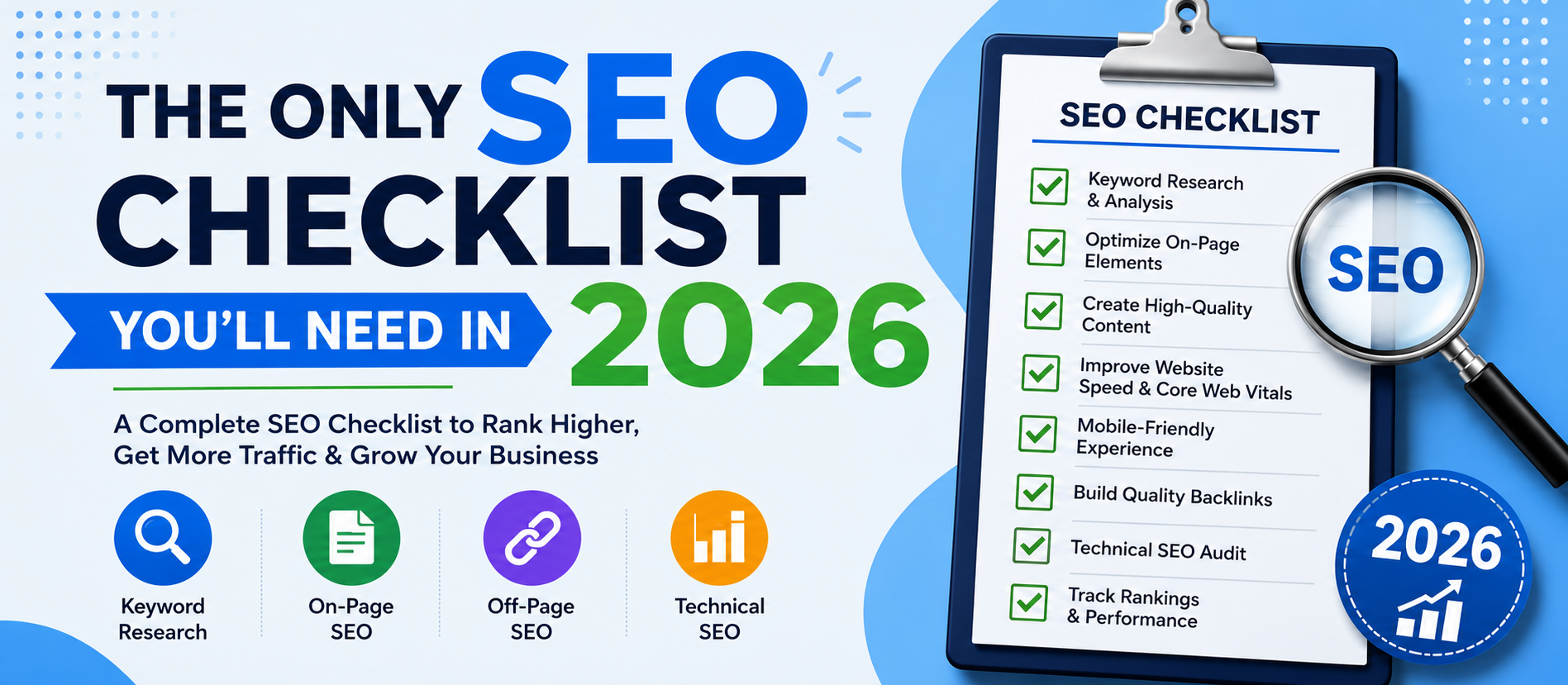
The Complete SEO Checklist for 2026
A step-by-step SEO checklist covering keywords, on-page optimization, technical fixes, content quality, and backlink building strategies.
If you've been in marketing long enough, you've seen the
same story play out. A client launches a new site, someone runs a quick audit,
a few obvious fixes go in, and rankings creep up for a month or two then stall.
Nine times out of ten, the problem isn't a lack of effort. It's a missing step
somewhere in the process that nobody circled back to check.
That's exactly why a proper SEO checklist matters. Not a
generic list copied from a random blog, but one that reflects how search
engines and now AI search platforms actually evaluate a site today. Below is a
checklist built around what tends to separate campaigns that plateau from
campaigns that keep climbing.
1. Get the Technical Foundation Right First
Content and links get all the attention, but none of it matters if search engines can't crawl or render your site properly.
- Check crawlability - Confirm your robots.txt isn't accidentally blocking important pages, and that your XML sitemap is submitted and error-free in Google Search Console.
- Fix Core Web Vitals - Page speed, load stability, and interactivity aren't "nice to have" anymore — they directly affect rankings. Run your key pages through Page Speed Insights and fix anything flagged as poor.
- Secure HTTPS everywhere - No mixed content warnings, no broken padlocks.
- Clean up duplicate content - Canonical tags should point to the correct version of every page, especially on e-commerce sites with filtered URLs.
- Fix broken links and redirect chains - A single 404 isn't fatal, but dozens of them tell search engines your site isn't maintained.
Skipping this step is like renovating a house on a cracked
foundation. Everything you build on top becomes harder to sustain.
2. Nail the On-Page Basics
On-page SEO is where most teams start — and where most teams stop too early.
- Title tags and meta descriptions: should include your target keyword naturally and give someone an actual reason to click, not just describe the page.
- One H1 per page: followed by a logical structure of H2s and H3s that mirror how a reader would scan the content.
- Keyword placement: should feel natural — in the first 100 words, a subheading or two, and the conclusion. Forcing it in every paragraph does more harm than good.
- Internal linking: connects related pages and passes authority around your site. If a blog post never links to a relevant service page, that's a missed opportunity.
- Image optimization: compressed file sizes, descriptive alt text, and file names that aren't "IMG_4821.jpg."
3. Build Content That Actually Answers Something
Search engines have gotten much better at telling the difference between content written to rank and content written to help. The gap keeps widening.
- Match search intent - Before writing anything, check what's currently ranking for your target keyword. If the top results are listicles and yours is a long opinion piece, you're fighting the wrong format.
- Go deeper than competitors - but no longer for the sake of length. A 2,500-word article that repeats itself loses to a tighter 1,200-word piece that says something useful.
- Show real expertise - Original data, case examples, or a genuine point of view carry more weight than another rehash of the same five tips.
- Update old content regularly - A two-year-old post with outdated stats or dead links can quietly drag down an otherwise strong site.
4. Don't Ignore Off-Page Signals
Rankings aren't decided by your site alone. What other parts of the internet say about you still counts for a lot.
- Earn backlinks from relevant, trustworthy sites - rather than chasing volume. Ten links from respected industry sources outperform a hundred from low-quality directories.
- Build brand mentions - even unlinked ones. Search engines increasingly treat consistent brand visibility as a trust signal.
- Keep your Google Business Profile active - if local search matters to you; reviews, updated hours, and fresh photos all play a role.
- Monitor your backlink profile - for anything toxic or spammy and disavow where necessary.
5. Prepare for AI Search, Not Just Google
This is the part of the checklist that's newest and the part
most teams skip entirely.
Search behavior is shifting. People increasingly ask ChatGPT, Gemini, or Perplexity a question instead of typing it into Google. Getting cited or recommended inside an AI-generated answer requires a slightly different approach than classic SEO:
- Structure content around clear, direct answers. To specific questions, not just broad topics.
- Use schema markup. So AI crawlers and traditional search engines alike can understand what your content is actually about.
- Build topical authority. By covering a subject thoroughly across multiple pages, rather than spreading thin across unrelated topics.
- Get cited on authoritative third-party sites. Since AI platforms tend to pull from sources they already trust.
Agencies working across both traditional SEO and this newer
AI-visibility space, including teams at Ksquare99 Web Services, have started treating AEO
and GEO as standard parts of an SEO checklist rather than a separate service.
It's a reasonable shift. The two are becoming harder to separate.
6. Track What Actually Matters
An SEO checklist isn't complete without a way to measure whether any of it worked.
- Organic traffic and keyword rankings - obvious, but check them against a real baseline, not just last week's numbers.
- Click-through rate from search results - A page ranking well but getting ignored usually has a title or meta description problem.
- Conversion rate from organic traffic - not just visits. Rankings that don't lead to leads or sales aren't doing their job.
- Search Console coverage reports - checked monthly, to catch crawl errors before they snowball.
Final Thought
None of this is complicated in isolation. The difficulty is
in doing all of it consistently, revisiting it as algorithms shift, and not
treating any single step as "done forever." SEO checklists don't work
as a one-time audit; they work as a habit.
Run through this list every quarter, adjust based on what your data shows, and you'll spend a lot less time wondering why rankings stalled and a lot more time watching them move.
Frequently Asked Questions
1. What should be included in an SEO checklist?
Keyword research, title tags, meta descriptions, header structure, internal linking, page speed, mobile-friendliness, and quality backlinks.
2. How often should I update my SEO checklist?
Review it every 3–6 months, since search engine algorithms and best practices change regularly.
3. Is an SEO checklist different for new vs. existing websites?
Yes — new sites focus more on setup basics (indexing, sitemaps, site structure), while existing sites emphasize content updates and technical audits.
4. Do I need technical SEO knowledge to use a checklist?
No, most checklists are designed for beginners, though some technical items (like schema markup) may require basic coding familiarity.
5. Can following an SEO checklist guarantee higher rankings?
No single checklist guarantees rankings, but consistently following one improves your site's visibility and search performance over time.