
 Book a call with us (30 Minute Meeting)



 Krishna Mishra
 14 September 2026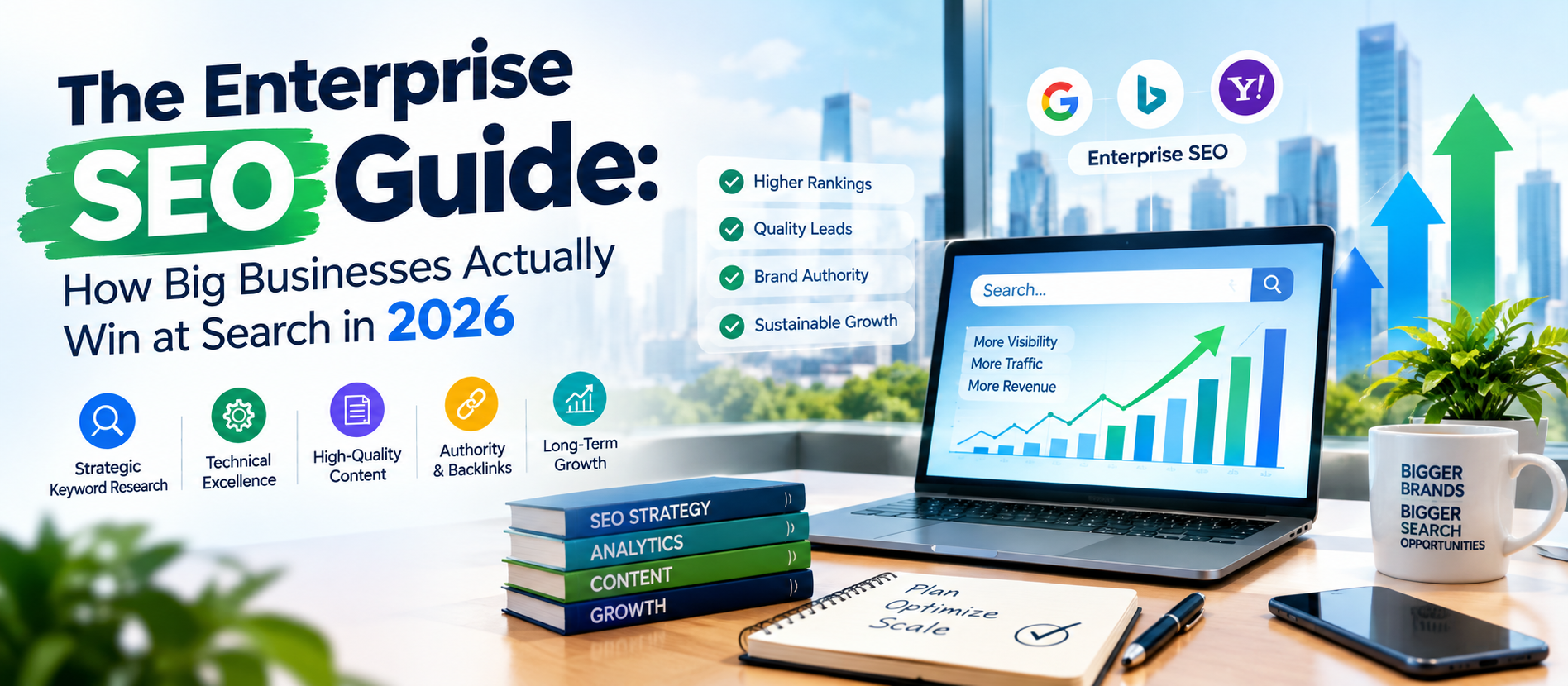
Enterprise SEO Guide: What Actually Works in 2026
Enterprise SEO Guide: master technical SEO, content authority, and team alignment to scale search visibility successfully.
If you're running SEO for a large company, you already know
it's a completely different beast compared to a small business website. You're
not dealing with one homepage and a handful of service pages. You're dealing
with thousands of URLs, multiple teams pulling in different directions, legacy
tech stacks, and approval chains that can turn a five-minute fix into a
five-week project.
This Enterprise SEO Guide is built for exactly that reality.
No fluff, no recycled basics — just what actually moves the needle when you're
managing search at scale.
What Makes Enterprise SEO Different
Small business SEO is mostly about doing the fundamentals
well: solid keywords, decent content, a few backlinks, and patience. Enterprise
SEO is a different game entirely, and here's why.
1. Scale changes everything
When your site has 50,000+
pages, a small technical issue doesn't affect one page — it affects thousands.
A broken canonical tag template can quietly tank rankings across an entire
category of pages before anyone notices.
2. More people, more friction
Enterprise SEO rarely
lives in one team's hands. Marketing wants campaigns live yesterday. IT has its
own release calendar. Legal needs to review every claim. Getting a single title
tag changed can require sign-off from three departments. Success depends as
much on process and communication as it does on SEO knowledge itself.
3. Brand risk is higher
A big brand's every page
reflects on its reputation. You can't just publish thin content and hope it
ranks — search engines and users both expect authority, accuracy, and trust
from established companies.
4. The competition is fiercer
You're no longer competing with local shops. You're up against other enterprises with bigger budgets,
bigger content teams, and years of accumulated authority.
Building the Foundation: Technical SEO at Scale
For large websites, technical SEO isn't a nice-to-have —
it's the backbone everything else depends on. A brilliant content strategy
means nothing if search engines can't crawl and index your pages properly.
1. Start with a full crawl audit.
Tools that can handle
enterprise-scale crawls will show you duplicate content, broken links, redirect
chains, and orphaned pages you didn't even know existed. On a site with tens of
thousands of URLs, these issues pile up fast if nobody's watching.
2. Fix your crawl budget problem.
Search engine bots
only spend a limited amount of time crawling your site. If that budget is
wasted on low-value pages, filter parameters, or duplicate content, search engines might not crawl your important pages often enough. Cleaning this up through
smart use of robots.txt, canonical tags, and internal linking makes a
measurable difference.
3. Get your site architecture right.
A logical URL
structure and clear internal linking help both users and search engines
understand what matters most on your site. If your best content is buried five
clicks deep, don't expect it to rank well.
4. Speed matters more than ever.
Core Web Vitals are a
ranking factor, and enterprise sites — often loaded with tracking scripts,
third-party widgets, and heavy media — tend to struggle here. Page speed
improvements at scale usually require developer involvement, so this is one
area where SEO and engineering teams need to work closely together.
Content Strategy for Large Organizations
Content is where enterprise SEO can either shine or
completely stall out, depending on how it's managed.
1. Avoid content silos
In big companies, different
departments often create content without talking to each other. The result?
Duplicate topics, keyword cannibalization, and a confusing experience for both
users and search engines. A centralized content strategy — even if execution
stays decentralized — solves this.
2. Focus on topical authority, not just keywords
Ranking
for one keyword is good. Being seen as the go-to authority on an entire topic
cluster is far more valuable and sustainable. This means building out
comprehensive content hubs rather than isolated blog posts.
3. E-E-A-T is non-negotiable.
Experience, Expertise,
Authoritativeness, and Trustworthiness matter for every business, but
enterprises are held to a higher standard, especially in finance, healthcare,
and other high-stakes industries. Author bios, cited data, expert reviews, and
transparent sourcing all help here.
4. Don't ignore existing content
Enterprise sites
usually have years of accumulated pages. Instead of only creating new content,
audit what already exists. Outdated pages that once ranked well can often be
refreshed and reclaim lost traffic faster than starting from scratch.
Managing SEO Across Multiple Teams
This is the part most SEO guides skip, but for enterprise
SEO, it might be the most important piece.
1. Create a shared SEO playbook
Document your standards
for URL structures, title tag formats, image alt text, and content guidelines.
When multiple teams are publishing content, a shared playbook keeps everyone
consistent without requiring constant oversight.
2. Build relationships with engineering early.
Most
enterprise SEO wins — site speed, structured data, redirects — need developer
resources. If SEO requests always get deprioritized behind product features,
very little gets shipped. Having a direct line to engineering leadership and
framing SEO requests in terms of business impact helps a lot.
3. Set up SEO governance
Someone needs to own SEO
quality across the organization, even if individual teams manage their own
sections. This could be a center-of-excellence model where a core SEO team sets
standards and reviews changes before they go live.
4. Report in business terms
Executives don't care about
keyword rankings as much as they care about revenue, leads, and market share.
Translating SEO metrics into business outcomes makes it far easier to secure
budget and buy-in for future projects.
Don't Forget AI Search Visibility
Search itself is changing fast. Platforms like ChatGPT,
Google AI Overviews, Gemini, and Perplexity are increasingly where people look
for answers, not just traditional search results pages. For enterprise brands,
this means SEO strategy now needs to stretch beyond Google rankings.
This is where Answer Engine Optimization (AEO) and Generative
Engine Optimization (GEO) come in — making sure your brand's content is
structured, authoritative, and citation-worthy enough to be pulled into
AI-generated answers. Enterprises that get ahead of this now, by building
well-structured, fact-backed, expert-reviewed content, will have a real
advantage as more search traffic shifts toward AI platforms.
Measuring What Actually Matters
With so many moving parts, enterprise SEO teams need
dashboards that go beyond simple ranking trackers.
- Organic
traffic by business unit or product line — so you can see which areas
are actually driving results
- Crawl
efficiency and indexation rates — a strong signal for technical health
at scale
- Conversion
and revenue attribution from organic search — the metric leadership
actually cares about
- Content
decay tracking — flagging pages that are losing traffic so they can be
refreshed before it's too late
Regular reporting cycles, whether weekly or monthly, keep
everyone aligned and make it easier to catch problems before they snowball
across thousands of pages.
Final Thoughts
Enterprise SEO isn't about knowing more SEO tricks than
everyone else. It's about managing complexity — technical, organizational, and
strategic — at a scale where small mistakes multiply fast. The businesses that
win here are the ones that treat SEO as a cross-functional discipline, not a
siloed marketing task.
Get the technical foundation right, build content with real authority behind it, keep your teams aligned, and don't lose sight of where search is heading next. Do that consistently, and enterprise SEO stops feeling like a moving target and starts becoming a genuine growth engine.
Frequently Asked Questions
1. What is enterprise SEO, and how is it different from regular SEO?
Enterprise SEO is search optimization for large organizations with big websites — often 10,000+ pages, multiple teams, and complex approval processes. Unlike small business SEO, it involves managing technical issues at scale, coordinating across departments, and handling much stiffer competition.
2. How long does enterprise SEO take to show results?
Because of the scale and internal processes involved, enterprise SEO usually takes longer to show results than smaller sites — often 4 to 6 months for noticeable movement, and 9 to 12 months for major gains. Larger sites simply have more pages to fix, more stakeholders to align, and more competitive keywords to chase.
3. Who should own SEO in a large organization?
Ideally, a dedicated SEO team or center of excellence sets the standards, while individual departments execute within those guidelines. Without clear ownership, different teams often end up creating duplicate content or working against each other's efforts without realizing it.
4. Why does enterprise SEO need developer involvement?
Many of the biggest technical SEO wins — page speed, structured data, fixing crawl issues — require changes to the website's code or infrastructure. Marketing teams can't do this alone, so a working relationship with engineering is essential for enterprise SEO to actually move forward.
5. Does enterprise SEO need to include AI search optimization too?
Yes. As more people get answers directly from ChatGPT, Google AI Overviews, and similar platforms, enterprise brands need content that's structured and authoritative enough to get cited there too. This is usually handled through Answer Engine Optimization (AEO) and Generative Engine Optimization (GEO), alongside traditional SEO.