
 Book a call with us (30 Minute Meeting)



 Krishna Mishra
 08 September 2026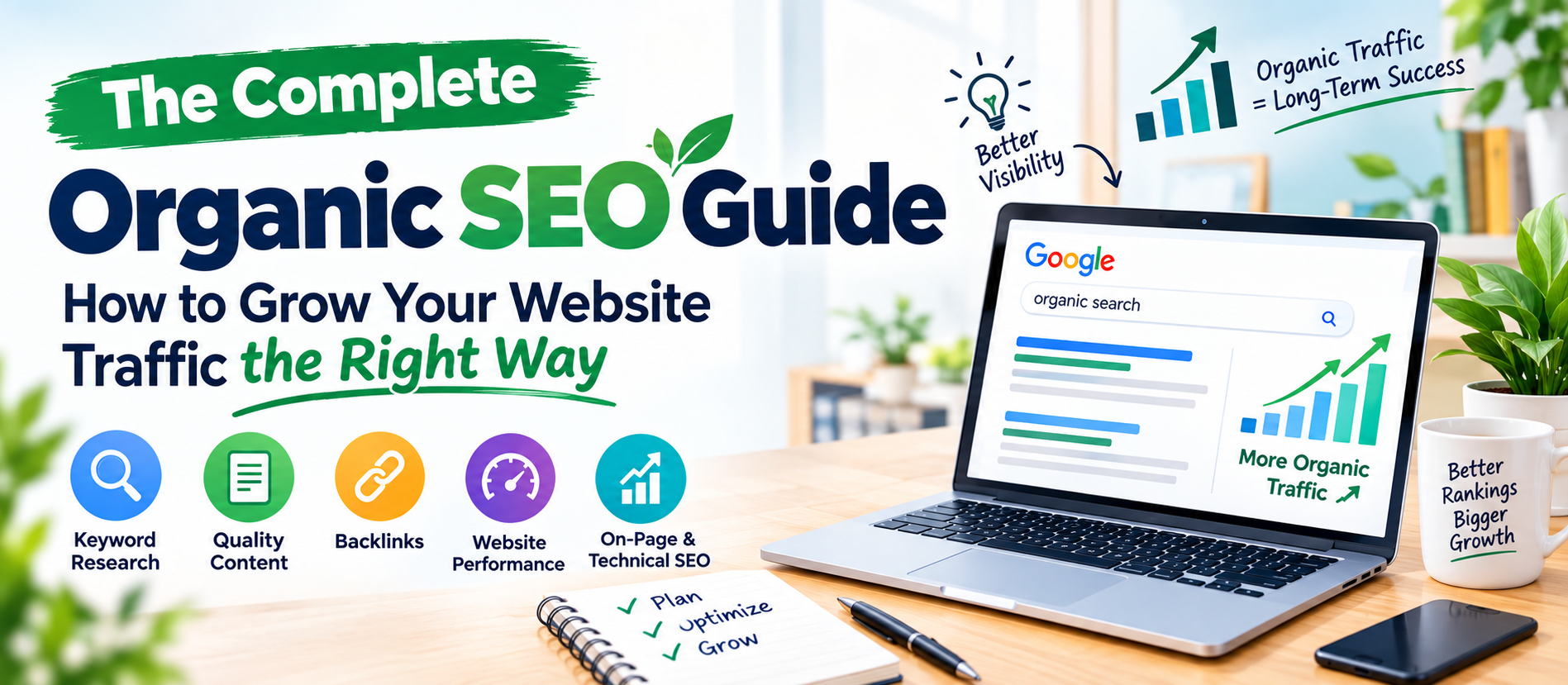
Organic SEO Guide: Grow Traffic the Right Way for 2026
Learn proven organic SEO strategies to improve rankings, attract targeted traffic, build authority, and achieve sustainable website growth without relying on paid ads.
If you own a website, you have probably heard the term
"SEO" a hundred times. But there is a big difference between paying
for traffic and earning it. That difference is called organic SEO, and it is
still the most reliable way to build a business online that does not disappear
the moment you stop paying for ads.
This organic SEO guide is written for real people, not
search engine robots. No jargon, no fluff, no confusing technical terms. Just a
clear, step-by-step way to understand how organic search works and how you can
use it to bring more visitors, more leads, and more sales to your website.
What Is Organic SEO?
Organic SEO means getting your website to show up in search
results naturally, without paying for placement. When someone types a question
into Google and your page appears on the first page without an "Ad"
label next to it, that is organic search.
The word "organic" is a good way to think about
it. Just like a garden needs the right soil, water, and sunlight to grow food
naturally, your website needs the right structure, content, and reputation to
grow traffic naturally. No shortcut replaces this process, and
that is actually good news, because it means your competitors cannot buy their
way past you either.
Why Organic SEO Still Matters in 2026
Some business owners assume SEO is old news now that AI
tools like ChatGPT, Gemini, and Google AI Overviews are becoming popular ways
to search for information. The truth is the opposite. These AI platforms pull
their answers from websites that already rank well organically. If your site
has weak SEO, it is far less likely to be mentioned, cited, or recommended by
an AI assistant either.
In other words, organic SEO is still the foundation. AI
search visibility is built on top of it, not instead of it.
A few reasons organic SEO continues to pay off:
- It
brings in visitors who are actively looking for what you offer, resulting in higher-quality leads.
- It
builds trust. People still trust organic results more than paid ads.
- It
keeps working overtime. A well-optimized blog post can bring traffic for
years.
- It
supports every other marketing channel, from social media to email to paid
ads.
Organic SEO vs Paid Search: What's the Difference?
Paid search, like Google Ads, gets you to the top of the
results page instantly, but only while you keep paying. The moment your budget
runs out, your traffic disappears with it.
Organic SEO takes longer to build. It usually takes a few
months before you see real movement in rankings. But once your pages start
ranking, they keep bringing visitors without an ongoing cost per click. Most
successful businesses use both: paid ads for quick wins and organic SEO for
long-term, sustainable growth.
The Main Pillars of a Strong Organic SEO Strategy
A good organic SEO strategy is not just one thing. It is a
combination of several parts working together. Here are the pillars that matter
most.
1. Keyword Research
Before you write a single word of content, you need to know
what your audience is actually searching for. Keyword research helps you
understand the exact phrases people type into Google when they are looking for
a product, service, or answer related to your business.
Good keyword research looks at:
- Search
volume (how many people search for this term)
- Search
intent (are they looking to buy, learn, or compare?)
- Competition
(how hard will it be to rank for this term?)
Instead of guessing what your customers want, this step
tells you exactly what to write about.
2. On-Page SEO
On-page SEO is everything you control directly on your
website pages. This includes:
- Writing
clear, keyword-focused page titles and meta descriptions
- Using
headings (H1, H2, H3) to organize content logically
- Adding
internal links between related pages
- Optimizing
images with descriptive file names and alt text
- Making
sure each page focuses on one main topic
Think of on-page SEO as good housekeeping. It helps search
engines understand what your page is about, and it helps your visitors actually
find what they came for.
3. Technical SEO
Technical SEO is the behind-the-scenes work that makes sure
search engines can crawl, understand, and index your website properly. Even the
best content in the world will not rank if search engines cannot access it.
Key technical SEO factors include:
- Website
loading speed
- Mobile-friendliness
- Secure
connection (HTTPS)
- Clean
URL structure
- No
broken links or duplicate content
- Proper
use of schema markup, which helps search engines and AI platforms
understand your content in more detail
4. High-Quality Content
Content is what actually earns rankings and keeps people on
your site. Search engines, especially Google, reward content that shows real
expertise, experience, authority, and trust, often referred to as E-E-A-T.
This means your content should:
- Answer
the reader's question completely
- Be
written by someone who understands the topic
- Include
real examples, data, or first-hand insight where possible
- Be
updated regularly so it stays accurate
Thin, repetitive, or copied content will not rank well, no
matter how many keywords you stuff into it.
5. Off-Page SEO and Link Building
Off-page SEO is about building your website's reputation
outside of your own domain. The most important part of this is link building,
which means getting other trustworthy websites to link back to your content.
Search engines see backlinks as a vote of confidence. If
several respected websites in your industry link to your page, that tells
search engines your content is valuable and worth ranking higher.
Good ways to build links naturally include:
- Publishing
genuinely useful research or guides that others want to reference
- Getting
featured in industry publications or news outlets
- Building
relationships with bloggers and journalists in your niche
- Guest
posting on relevant, reputable websites
Avoid buying links from low-quality websites. It can lead to
penalties that undo months of hard work.
6. Local SEO
If your business serves a specific city or region, local SEO
is essential. This includes optimizing your Google Business Profile, gathering
genuine customer reviews, and making sure your business name, address, and
phone number are consistent across the web.
Local SEO helps you show up when someone searches for
something "near me" or searches for your service along with a city
name.
A Step-by-Step Organic SEO Guide for Beginners
Here is a simple roadmap you can follow if you are starting
from scratch.
Step 1: Audit your current website. Check for broken
links, slow-loading pages, missing meta tags, and duplicate content. You cannot
fix what you do not know is broken.
Step 2: Do thorough keyword research. Find out what
your target audience is actually searching for, and group those keywords by
topic.
Step 3: Fix technical issues. Improve site speed,
make sure the site works well on mobile, and ensure search engines can crawl
every important page.
Step 4: Optimize your existing pages. Update titles,
meta descriptions, headings, and internal links based on your keyword research.
Step 5: Create new, valuable content. Fill gaps in
your website with blog posts, guides, and service pages that answer real
questions your audience is asking.
Step 6: Build genuine backlinks. Reach out to
relevant websites, contribute guest content, and create content worth linking
to.
Step 7: Track your results. Use tools like Google
Search Console and Google Analytics to see which pages are ranking, which
keywords are bringing traffic, and where you can improve.
Step 8: Repeat and refine. SEO is not a one-time project. Search engines update their algorithms regularly, and your competitors are working too. Review your strategy every few months.
How Long Does Organic SEO Take to Work?
This is one of the most common questions business owners
ask, and the honest answer is that it depends. Most websites start to see
noticeable movement within 60 to 90 days, depending on the industry,
competition level, and the website's current health. Highly competitive
industries, or websites with little history and few backlinks, may take longer.
Organic SEO is a long-term investment. It is not a switch
you flip on. It is closer to compound interest: the earlier you start doing it
correctly, the bigger the payoff later.
Organic SEO and the Rise of AI Search
Search behavior is changing. People are asking questions
directly to AI tools like ChatGPT, Gemini, Perplexity, and Google AI Overviews,
expecting a direct answer instead of a list of links. This is where Answer
Engine Optimization (AEO) and Generative Engine Optimization (GEO) come in.
The good news is that the fundamentals barely change. AI
platforms still favor content that is well-structured, factually accurate, and
backed by genuine authority and trustworthy sources. If your organic SEO
foundation is strong, structured with clear headings, backed by credible
information, and supported by real backlinks, you are already in a good
position to be picked up and cited by AI search tools as well.
Final Thoughts
Organic SEO is not about tricking search engines. It is
about genuinely making your website the best possible answer to what your
audience is searching for. That means fast, mobile-friendly pages, content that
actually helps people, and a reputation built through real relationships and
quality work, not shortcuts.
It takes patience, consistency, and a willingness to keep
learning as search engines evolve. But unlike paid advertising, the results you
build with organic SEO keep working for you long after the initial effort is
done.
If you are just getting started, focus on one pillar at a time: get your technical foundation right, understand what your audience is searching for, create content that genuinely helps them, and build your reputation with real backlinks. Do this consistently, and organic growth will follow.
Frequently Asked Questions
What is organic SEO?
Organic SEO (Search Engine Optimization) is the practice of
improving a website's visibility in unpaid, "natural" search engine
results — as opposed to paid ads (PPC). It involves optimizing content, site
structure, and authority signals so search engines like Google understand and
rank your pages higher for relevant queries.
How is organic SEO different from paid search?
Paid search (like Google Ads) gets you placement instantly,
but only as long as you keep paying. Organic SEO takes longer to build but
delivers traffic without a per-click cost, and results tend to compound over
time as your site gains authority and trust.
How long does organic SEO take to show results?
Most sites start seeing meaningful movement in 3 to 6
months, with more substantial results in 6 to 12 months. Timelines
depend on:
- Domain
age and existing authority
- Competitiveness
of your target keywords
- Content
quality and publishing frequency
- Technical
health of the site
- How
aggressively competitors are also optimizing
What are the main pillars of organic SEO?
- Technical
SEO — site speed, mobile-friendliness, crawlability, indexability,
structured data, secure (HTTPS) setup
- On-page
SEO — keyword targeting, title tags, meta descriptions, header
structure, internal linking, content quality
- Off-page
SEO — backlinks, brand mentions, digital PR, social signals
- Content
strategy — creating pages that match search intent and answer users'
questions thoroughly
- User
experience (UX) — engagement metrics like dwell time, bounce rate, and
Core Web Vitals
How do I find the right keywords to target?
Start by identifying terms your audience actually searches
for, using tools like Google Keyword Planner, Ahrefs, SEMrush, or Ubersuggest.
Look for a balance of:
- Search
volume (enough people are searching)
- Keyword
difficulty (realistic to rank for, given your site's authority)
- Search
intent (informational, navigational, commercial, or transactional)
- Relevance
to your actual product or content
Long-tail keywords (longer, more specific phrases) are often
easier to rank for and convert better.