
 Book a call with us (30 Minute Meeting)



 Krishna Mishra
 24 August 2026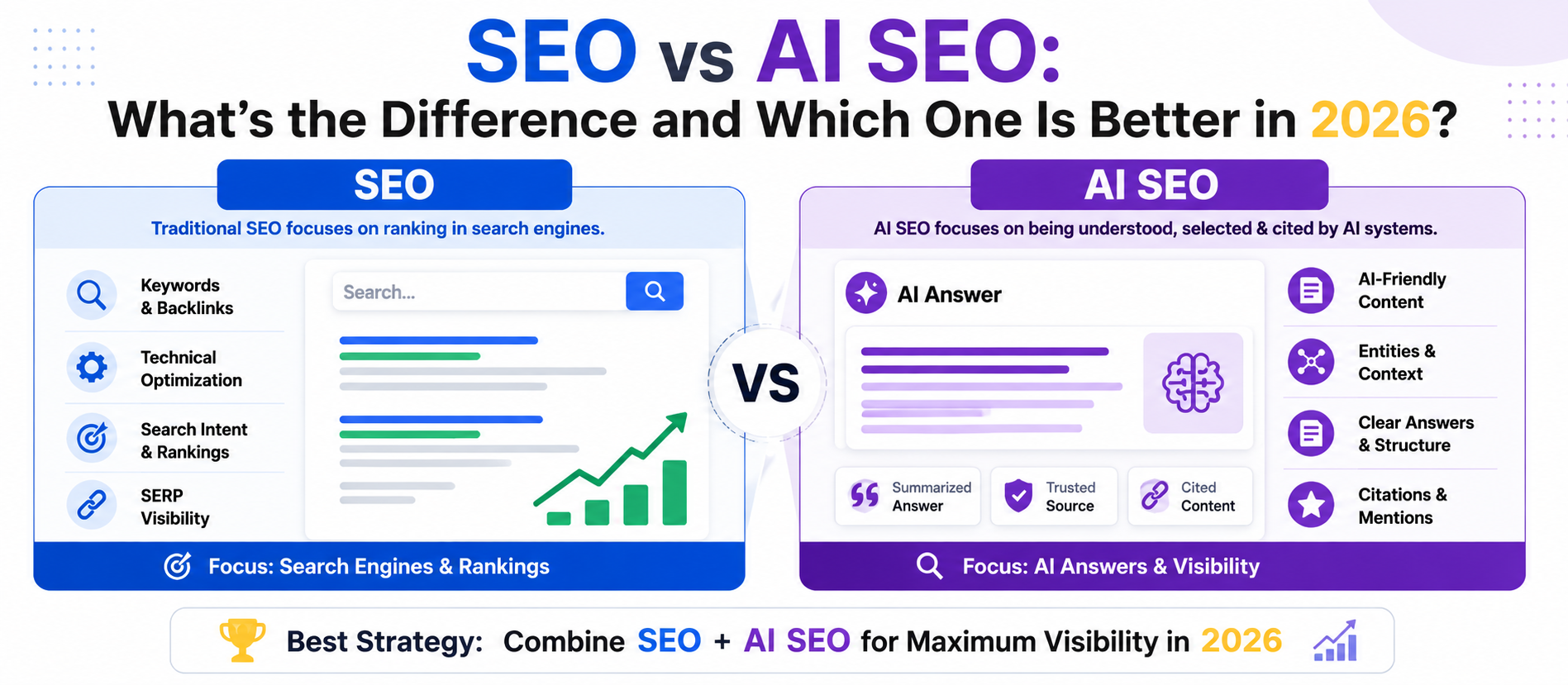
Traditional SEO uses proven optimization techniques, while AI SEO leverages artificial intelligence to improve rankings, content, and search visibility.
If you've spent any time googling how to grow your website
traffic lately, you've probably run into two terms that get thrown around a
lot: SEO and AI SEO. At first glance, they sound like they mean
the same thing. They don't. And if you're a business owner trying to figure out
where to allocate your marketing budget, understanding the difference matters more than ever.
Let's break it down in plain language, no jargon overload,
just what you actually need to know.
What is SEO, really?
SEO stands for Search Engine Optimization. In simple terms,
it's the practice of making your website easy for Google (and other search
engines) to find, understand, and rank well. When someone searches "best
coffee shop near me" or "affordable web design services," SEO is
what decides whether your website shows up on page one or gets buried on page
five where nobody ever scrolls.
Traditional SEO usually covers a few core areas:
- On-page
SEO – things like your page titles, headings, content quality, and
keyword usage
- Technical
SEO – site speed, mobile-friendliness, clean code, and proper indexing
- Off-page
SEO – backlinks, brand mentions, and overall domain authority
- Local
SEO – optimizing your Google Business Profile so nearby customers can
find you
This has been the backbone of digital marketing for over two
decades. And honestly, it still works. Businesses that rank well on Google get
consistent, high-intent traffic without paying for every single click.
So What is AI SEO?
Here's where things get interesting. AI SEO isn't a
replacement for traditional SEO — think of it as the next layer on top of it.
Search behavior has changed. People aren't just typing short
queries into Google anymore. They're asking full questions to ChatGPT, Google's
AI Overviews, Gemini, Perplexity, and Claude, and expecting a direct answer,
not just a list of blue links. AI SEO (sometimes called AEO — Answer Engine
Optimization, or GEO — Generative Engine Optimization) is the practice of
getting your brand mentioned, cited, or recommended inside those AI-generated
answers.
Instead of just asking "will Google rank this
page," AI SEO asks a different question: "will an AI model trust this
content enough to reference it when answering a user's question?"
That shift changes quite a bit about how content needs to be
built.
SEO vs AI SEO: The Key Differences

Does AI SEO Replace Traditional SEO?
No, and this is the part a lot of people get wrong. AI
models like ChatGPT and Gemini still rely heavily on content that ranks well
organically. If your website has weak SEO fundamentals, it's far less likely to
be picked up as a trustworthy source for an AI-generated answer in the first
place.
In other words, strong traditional SEO is often the
foundation that AI SEO builds on. You can't really skip one and expect the
other to work well.
Why This Matters for Your Business Right Now
Search is no longer a single channel. A potential customer
might:
- Ask
ChatGPT for a recommendation
- Search
directly on Google
- See an
AI Overview answer before ever clicking a link
- Ask
Alexa or Siri a voice-based question
If your business only shows up in one of these places,
you're missing a growing chunk of potential customers. That's exactly why more
agencies — including ours at Ksquare99 — now build strategies that combine
classic SEO with AEO and GEO, so brands stay visible whether someone is
searching on Google or asking an AI assistant.
How to Prepare Your Website for Both
You don't need to pick a side. Here's a practical approach:
- Keep
your technical SEO solid. Fast load times, mobile optimization, and
clean site structure still matter for both search engines and AI crawlers.
- Write
content that directly answers questions. Clear, structured answers
(think FAQs, definitions, step-by-step explanations) are easier for AI
tools to pull from.
- Build
genuine authority. Backlinks, mentions from credible sources, and
consistent branding across the web help both Google's algorithm and AI
models trust your content.
- Use
structured data and schema markup. This helps machines — search
engines and AI alike — understand exactly what your content is about.
- Track
new metrics. Don't just watch your Google rankings. Start monitoring
whether your brand shows up in ChatGPT, Perplexity, or AI Overview
responses.
Final Thoughts
SEO and AI SEO aren't rivals — they're two parts of the same
puzzle. Traditional SEO gets you found on search engines. AI SEO gets you
recommended by the AI tools more and more people are using instead of typing a
search query. Businesses that invest in both now will have a real head start
over competitors who are still treating this as an either-or decision.
If you're not sure where your website currently stands on either front, a good starting point is a simple audit — check your search rankings, then check whether AI tools even know your brand exists.
Frequently Asked Questions
1. What is the difference between SEO and AI SEO?
Traditional SEO focuses on optimizing websites for search
engines using keywords, content, backlinks, technical SEO, and user experience.
AI SEO uses artificial intelligence to analyze data, identify search
trends, optimize content, and adapt to AI-powered search experiences.
2. Is AI SEO better than traditional SEO in 2026?
Not necessarily. The best approach in 2026 is to combine
traditional SEO with AI SEO. Traditional SEO provides a strong technical and
content foundation, while AI can improve research, optimization, analysis, and
efficiency.
3. Does AI SEO replace traditional SEO?
No. AI SEO does not completely replace traditional SEO.
Search visibility still depends on factors such as useful content, website
quality, technical performance, authority, and user experience.
4. How does AI help with SEO?
AI can help with keyword research, content ideas,
search-intent analysis, competitor research, content optimization, internal
linking, and SEO data analysis. It can automate repetitive tasks and help
marketers work more efficiently.
5. Can AI-generated content rank on Google?
AI-generated content can potentially rank if it provides helpful,
original, accurate, and valuable information. Simply generating large
amounts of low-quality or unoriginal content is not a reliable SEO strategy.