
 Book a call with us (30 Minute Meeting)



 Krishna Mishra
 24 August 2026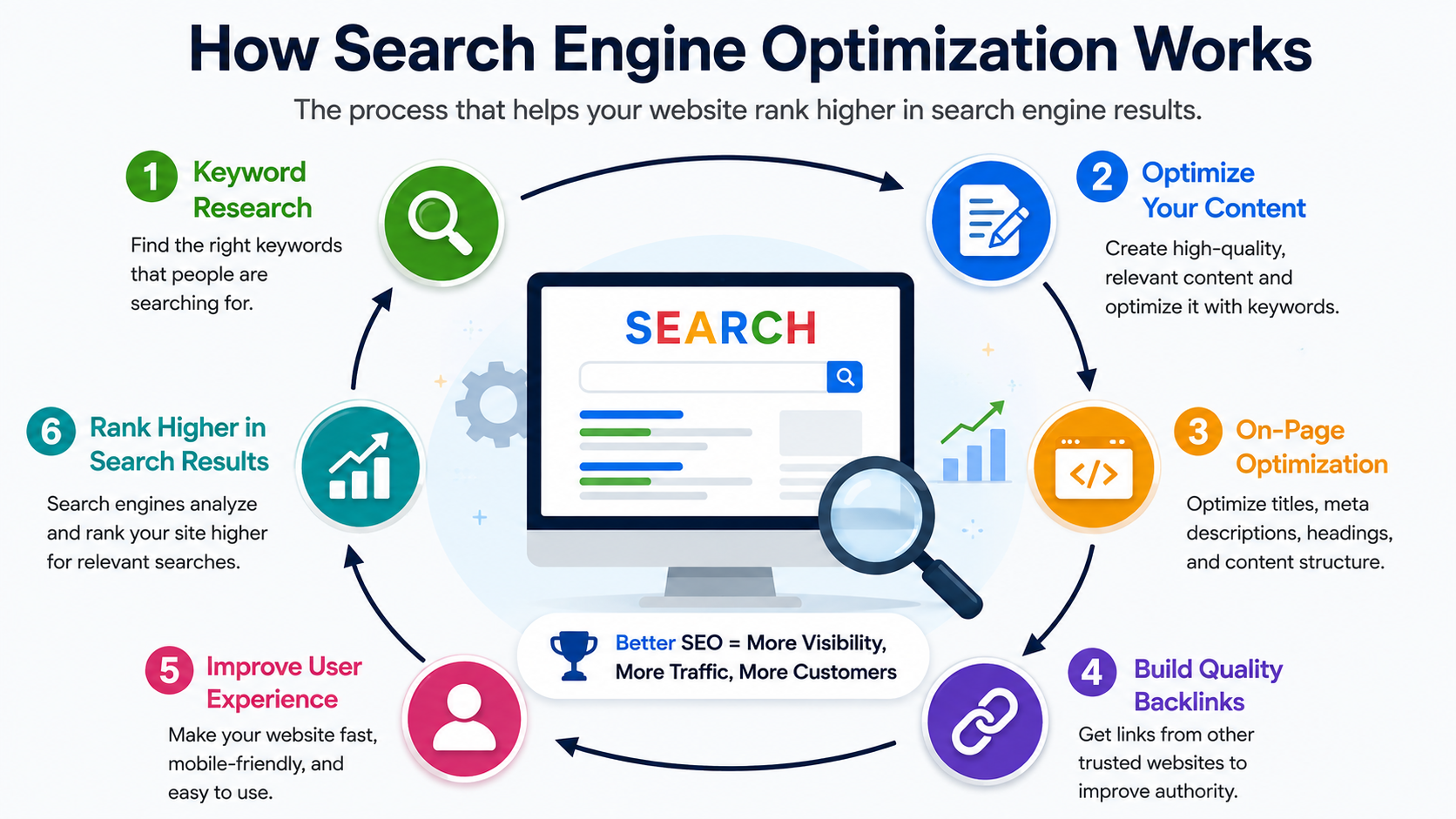
How Search Engine Optimization Works: A Complete Guide for Business Owners
Search Engine Optimization Works: Crawling, indexing, and ranking web pages based on relevance, quality, backlinks, and user experience.
If you have ever typed a question into Google and gotten an
instant list of helpful websites, you have seen search engine optimization in
action. But have you ever wondered what actually happens behind the scenes? How
does Google decide which pages show up first, and which ones get buried on page
ten where nobody ever looks?
That is exactly what we are going to break down in this
guide. We will walk through how search engine optimization works, step by step,
in plain and simple language. No confusing jargon, no technical overload — just
a clear explanation that any business owner, student, or curious reader can
follow.
By the end, you will understand why SEO matters so much for
online visibility, and what it actually takes to get a website ranking well on
Google.
What Is Search Engine Optimization, really?
Search engine optimization, or SEO, is the practice of
improving a website so that search engines like Google, Bing, and Yahoo can
understand it better and show it to more people. Think of it as making your
website easy to find, easy to trust, and easy to read — for both machines and
humans.
When done right, SEO helps a website appear higher in search
results for the words and phrases people are actually typing in. Higher
rankings mean more visitors, more visitors mean more potential customers, and
more customers mean real business growth.
But to understand how search engine optimization works, we
first need to understand how search engines themselves work.
Step 1: Crawling — How Google Finds Your Website
Before Google can rank any page, it first needs to discover
it. This is where crawling comes in.
Google uses automated programs called "crawlers"
or "spiders" (the most well-known one is called Googlebot) that
travel across the internet, jumping from link to link, much like a person
clicking from one page to another. These crawlers visit websites, scan their
pages, and follow the links they find to discover new pages.
If your website has no links pointing to it, and search
engines don't know it exists, it may never get crawled at all. This is why
things like submitting a sitemap to Google Search Console, building quality
backlinks, and maintaining clean internal linking are so important. They give
crawlers clear pathways to explore your entire site.
Step 2: Indexing — How Google Stores and Understands Your Content
Once a page is crawled, Google doesn't just glance at it and
move on. It analyzes the content in detail and stores useful information about
that page in a massive database called the "index." Think of the
index as a giant digital library containing billions of web pages.
During indexing, Google looks at several things:
- The
words and topics covered on the page
- Images,
videos, and other media
- The
structure of the content (headings, paragraphs, lists)
- How
the page is coded (technical elements like meta tags and schema markup)
- Whether
the page is mobile-friendly and loads quickly
If a page has thin content, duplicate content, or technical
errors, Google may choose not to index it at all. That means the page simply
won't show up in search results, no matter how good it looks to a human
visitor.
Step 3: Ranking — How Google Decides What Shows Up First
This is the part most people are curious about. Once pages
are indexed, Google needs to decide, out of billions of pages, which ones
deserve to appear at the top when someone searches for a specific term.
Google uses a complex ranking algorithm that considers
hundreds of factors. While the exact formula is a closely guarded secret, years
of industry research and Google's own public guidance have made the major
ranking factors fairly clear. Here are the ones that matter most:
1. Relevance of Content
Does the page actually answer the searcher's question?
Google tries to match search intent with the most helpful, accurate, and
complete content available.
2. Quality and Depth of Content
Well-researched, well-organized content that thoroughly
covers a topic tends to perform better than short, thin, or generic pages.
3. Backlinks From Trusted Websites
When other reputable websites link back to your page, it
acts like a vote of confidence. Google sees these backlinks as a sign that your
content is valuable and trustworthy.
4. Website Experience (Core Web Vitals)
Page loading speed, visual stability, and how easily people
can interact with your site all affect rankings. A slow or clunky website
frustrates visitors, and Google notices that.
5. Mobile-Friendliness
Since most searches now happen on mobile devices, Google
primarily looks at the mobile version of your website when deciding rankings.
6. E-E-A-T: Experience, Expertise, Authoritativeness, and Trustworthiness
Google pays close attention to whether content is created by
someone with real experience and expertise on the topic, and whether the
website as a whole feel trustworthy and authoritative.
7. On-Page SEO Elements
Title tags, meta descriptions, header tags, keyword usage,
image alt text, and internal linking all help Google understand what a page is
about and how it fits into the rest of your website.
8. User Behavior Signals
How long people stay on a page, whether they click through
to other pages, and whether they quickly bounce back to the search results can
all send indirect signals about content quality.
The Two Main Pillars of SEO: On-Page and Off-Page
Now that you know how search engines crawl, index, and rank
pages, let's look at how SEO professionals actually work to improve those
rankings.
On-Page SEO
On-page SEO refers to everything you control directly on
your website. This includes:
- Choosing
the right target keywords based on what your audience is actually
searching for
- Writing
clear, helpful, and well-structured content
- Optimizing
title tags and meta descriptions
- Using
header tags (H1, H2, H3) properly to organize content
- Adding
descriptive alt text to images
- Improving
internal linking between related pages
- Making
sure the site loads fast and works well on mobile
Off-Page SEO
Off-page SEO refers to actions taken outside your own
website to build its reputation and authority. This mainly includes:
- Earning
backlinks from other trustworthy and relevant websites
- Building
brand mentions across the web
- Encouraging
social sharing and engagement
- Managing
online reviews and reputation
- Getting
listed in relevant business directories and citations
Both on-page and off-page SEO work together. Great content
without any backlinks may struggle to rank, and lots of backlinks pointing to
poor content won't help either. A balanced approach is what drives long-term
results.
Technical SEO: The Foundation Nobody Sees
Alongside on-page and off-page SEO, there's a third pillar
that often gets overlooked: technical SEO. This covers the behind-the-scenes
elements that help search engines crawl and index your site efficiently, such
as:
- Website
speed and performance
- Secure
connections (HTTPS)
- XML
sitemaps
- Structured
data and schema markup
- Fixing
broken links and redirect errors
- Making
sure there's no duplicate content confusing search engines
Without a solid technical foundation, even the best content
can struggle to get discovered and ranked properly.
Why SEO Takes Time
One of the most common questions business owners ask is,
"Why isn't my website ranking yet?" The honest answer is that SEO is
not an instant fix it is an ongoing process.
Search engines need time to crawl your updated content,
evaluate its quality, compare it against competitors, and build enough trust
signals before rewarding it with higher rankings. Most SEO experts agree that
noticeable results usually start appearing within two to three months, with
stronger, more stable growth building over six months to a year.
This is very different from paid advertising, where results
appear the moment your budget is active but disappear the moment you stop
paying. SEO, on the other hand, builds long-term, compounding value. Once your
website earns strong rankings and authority, that visibility tends to stick
around and keep bringing in visitors month after month.
How AI Search Is Changing the SEO Game
Search engine optimization is evolving quickly. With the
rise of AI-powered platforms like Google AI Overviews, ChatGPT, Gemini, and
Perplexity, people are no longer just clicking through blue links. They are
getting direct answers generated by AI.
This has given rise to newer practices like Answer Engine
Optimization (AEO) and Generative Engine Optimization (GEO), which focus on
making content clear, well-structured, and authoritative enough to be picked up
and cited by AI systems, not just traditional search engines.
The core principles remain the same, though helpful,
well-organized, and trustworthy content still wins, whether it's being read by
a human, a search engine crawler, or an AI model.
Final Thoughts
So, how does search engine optimization work? In short, it's
the process of helping search engines discover your website through crawling,
understand it through indexing, and reward it with visibility through ranking based on relevance, quality, trust, and user experience.
SEO isn't a one-time task. It's a continuous effort
involving strong content, solid technical foundations, and genuine authority
building. Businesses that treat SEO as a long-term investment, rather than a
quick trick, are the ones that see real, lasting growth in their online
visibility.
If you're looking to strengthen your website's search
presence with a data-driven, transparent approach, working with an experienced
SEO team can help you avoid common mistakes and build a strategy tailored to
your industry and goals.