
 Book a call with us (30 Minute Meeting)



 Krishna Mishra
 17 September 2026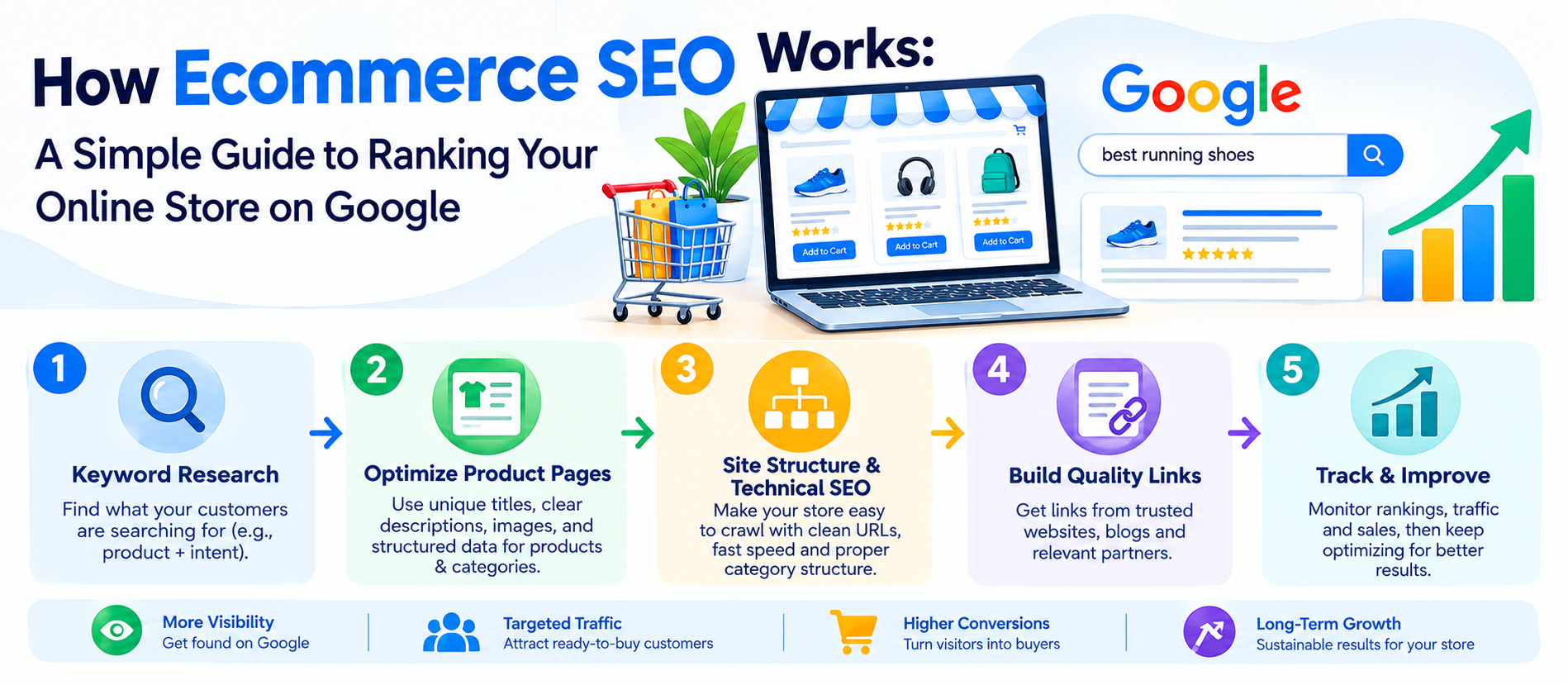
How Ecommerce SEO Works: A Complete Guide to Ranking Your Online Store
Learn how ecommerce SEO works and get proven strategies to rank your online store higher, drive organic traffic, and boost sales.
If you run an online store, you already know the biggest
problem isn't building the website. It's getting people to actually find it.
You can have the best products, the smoothest checkout, and the prettiest
design, but if nobody sees your store on Google, none of that matters.
This is where ecommerce SEO comes in.
In this guide, we'll break down exactly how ecommerce SEO
works, step by step, in plain and simple language. No confusing jargon, no
fluff. Just what you need to know to get your store ranking, get more visitors,
and turn that traffic into sales.
What Is Ecommerce SEO?
Ecommerce SEO is the process of optimizing your online store
so it shows up higher in search engine results when people search for products
you sell. Think of it as the bridge between someone typing "buy running
shoes for women" into Google and them landing on your product page instead
of a competitor's.
Unlike regular SEO for blogs or service websites, ecommerce
SEO has its own set of challenges. You're not just optimizing a handful of
pages. You might have hundreds or thousands of product pages, category pages,
filters, and variations, all of which need to be structured properly so search
engines can understand and rank them.
Why Ecommerce SEO Matters More Than Ever
Paid ads can bring in quick traffic, but the moment you stop
paying, the traffic stops too. SEO is different. Once your pages start ranking
organically, they keep bringing in visitors month after month without you
paying for every single click.
For online stores, this means:
- Lower
cost per sale over time
- More
trust, since people naturally trust organic results more than ads
- Long-term,
sustainable growth instead of a traffic tap that turns off when the budget
runs out
Now let's get into how it actually works.
1. Keyword Research: Finding What Your Customers Are Searching For
Everything in ecommerce SEO starts with keywords. These are
the exact words and phrases your potential customers type into Google before
they buy something.
For an online store, keywords usually fall into three
buckets:
Transactional keywords — these show strong buying
intent, like "buy leather wallet online" or "wireless earbuds
under 2000."
Informational keywords — these are searches where
people are still researching, like "best fabric for summer clothes"
or "how to choose a laptop bag."
Navigational keywords — searches for a specific brand
or product, like "Nike Air Max 270."
A good ecommerce SEO strategy targets all three. Put transactional keywords on your product and category pages, since those are
closest to a purchase. Informational keywords are perfect for blog content that
brings in early-stage shoppers and builds trust before they buy.
The trick isn't just finding keywords with high search volume, but finding ones that match what your store sells and what
your ideal customer is looking for.
2. Site Structure: Making It Easy for Google to Understand Your Store
Search engines need to crawl and understand your website
before they can rank it. If your site structure is messy, Google can get
confused, and confused search engines don't rank you well.
A clean ecommerce site structure usually looks like this:
Homepage → Category Page → Subcategory Page → Product Page
Every page should be reachable within three or four clicks
from your homepage. This is often called a "flat" site structure, and
it helps both users and search engines navigate your store easily.
Good internal linking also plays a big role here. Linking
related products together, linking blog posts to relevant product pages, and
using clear breadcrumb navigation all help spread SEO value across your site.
3. On-Page SEO for Product and Category Pages
This is where a lot of ecommerce stores lose out on
rankings, simply because their product pages aren't optimized properly.
Here's what matters most on a product page:
Unique product titles that include the main keyword
naturally, not stuffed unnaturally.
Original product descriptions. Copying the
manufacturer's description word for word is one of the most common mistakes
online stores make. It creates duplicate content, which search engines don't
reward. Write your own description that highlights real benefits, not just
specifications.
Optimized images with descriptive file names and alt
text, since many customers search for products through Google Images too.
Clear pricing and availability information, since
search engines favor pages that give users what they're looking for right away.
Customer reviews, which naturally add fresh,
keyword-rich content to your page while also building trust.
Category pages need attention too. Adding a short, helpful
description at the top or bottom of a category page (not just a wall of product
tiles) gives search engines context about what that page is about.
4. Technical SEO: The Foundation Nobody Sees but Everyone Feels
Technical SEO is the behind-the-scenes work that makes your
store fast, secure, and easy to crawl. Even the best content won't rank if the
technical side is broken.
Key technical factors for ecommerce stores include:
Page speed. Online shoppers are impatient. If your
product page takes more than a few seconds to load, many visitors leave before
they even see it, and Google notices that too.
Mobile-friendliness. A huge share of online shopping
now happens on phones. Your site needs to work smoothly on smaller screens.
Secure checkout (HTTPS). This isn't optional anymore.
Search engines and customers both expect a secure connection.
Fixing duplicate content from filters and variations.
Ecommerce sites often create multiple URLs for the same product because of
size, color, or sorting filters. Using canonical tags helps tell search engines
which version is the main one to rank.
Structured data (schema markup). This helps search
engines show rich results like star ratings, pricing, and stock availability
directly in search listings, which can dramatically improve click-through
rates.
Fixing broken links and out-of-stock pages. When a
product goes out of stock permanently, redirecting that page properly (instead
of leaving a dead link) protects your SEO value.
5. Content Marketing: Bringing in Shoppers Before They're Ready to Buy
Not everyone who could buy from you is ready to buy today.
Many people are still comparing options, reading reviews, or figuring out what
they even need.
This is where a blog becomes valuable for an online store.
Content like buying guides, comparison articles, and how-to posts helps you
show up for those early searches, build trust with readers, and guide them
naturally toward your product pages through internal links.
For example, a store selling kitchen appliances could write
a blog post like "How to Choose the Right Mixer Grinder for Your
Kitchen" and naturally link to their product pages inside it. This brings
in traffic that a plain product page never could reach on its own.
6. Backlinks: Building Trust in the Eyes of Search Engines
Backlinks are links from other websites pointing to yours.
Search engines treat these as votes of confidence. The more relevant, quality
websites that link to your store, the more trustworthy your site appears.
For ecommerce brands, backlinks can come from:
- Product
reviews and mentions on blogs
- Being
featured in "best of" roundup articles
- Collaborations
with influencers who link back to your store
- Press
coverage and digital PR
- Supplier
or manufacturer websites linking to authorized sellers
Quality matters far more than quantity here. A handful of
links from respected, relevant websites will do more for your rankings than
hundreds of low-quality links.
7. User Experience and Conversion Signals
Search engines pay attention to how people behave on your
site after clicking through from search results. If visitors land on your page
and leave immediately, that's a signal that something isn't matching their
expectations.
Things that improve both user experience and, indirectly,
your SEO include:
- Simple,
distraction-free navigation
- Clear
calls to action
- Easy-to-use
filters and search bars
- A
smooth, few-step checkout process
- Fast-loading
pages across every device
Good ecommerce SEO isn't only about ranking. It's about
ranking with pages that actually convert visitors into customers once they
arrive.
How Long Does Ecommerce SEO Take to Show Results?
This is one of the most common questions store owners ask,
and honestly, there's no fixed answer. It depends on your industry,
competition, the current state of your website, and how consistently the
strategy is executed.
That said, most online stores start noticing meaningful
movement in rankings and traffic within 3 to 6 months of consistent,
well-planned SEO work. Highly competitive categories can take longer, while
niche products with less competition can see faster results.
The important thing to remember is that ecommerce SEO is not
a one-time fix. It's an ongoing process of refining, testing, and improving as
search engines update their algorithms and customer behavior shifts.
Final Thoughts
Ecommerce SEO works by combining several moving parts-
keyword research, site structure, on-page optimization, technical health,
content, backlinks, and user experience- into one strategy that helps search
engines understand your store and trust it enough to rank it well.
None of these pieces work in isolation. A store with perfect
technical SEO but no content strategy will struggle. A store with great content
but a slow, broken website will struggle just as much. The stores that win in
the long run are the ones that treat SEO as a complete system, not a checklist
of quick fixes.
If managing all of this alongside running your actual
business feels overwhelming, that's exactly the kind of work an experienced SEO
team can take off your plate. At Ksquare99, we've spent over a decade
helping online stores build SEO strategies that actually move the needle, from
technical audits to content and link building, so your store shows up where
your customers are already searching.
If you're ready to see where your store currently stands, a good first step is a free SEO audit to understand exactly what's holding your rankings back and what to fix first.
Frequently Asked Questions
1. What is ecommerce SEO?
Ecommerce SEO is the process of optimizing an online store —
product pages, category pages, images, and site structure — so it ranks higher
in search results and attracts more organic (non-paid) traffic.
2. How is ecommerce SEO different from regular SEO?
Regular SEO usually focuses on a handful of pages, like blog
posts or service pages. Ecommerce SEO deals with hundreds or thousands of
product and category pages, along with challenges like duplicate content from
filters, out-of-stock pages, and product variations.
3. How long does it take to see results from ecommerce SEO?
Most online stores start seeing noticeable movement in
rankings and traffic within 3 to 6 months of consistent SEO work. Highly
competitive product categories can take longer, while niche products often rank
faster.
4. Do I need to write unique descriptions for every product?
Yes. Copying manufacturer descriptions word-for-word creates
duplicate content, which hurts rankings. Writing original, benefit-focused
descriptions for each product helps you rank better and connect with shoppers.
5. Does site speed really affect ecommerce SEO?
Yes, significantly. Slow-loading pages lead to higher bounce
rates and lost sales, and search engines factor page speed into rankings —
especially for mobile searches.