
 Book a call with us (30 Minute Meeting)



 Krishna Mishra
 17 October 2026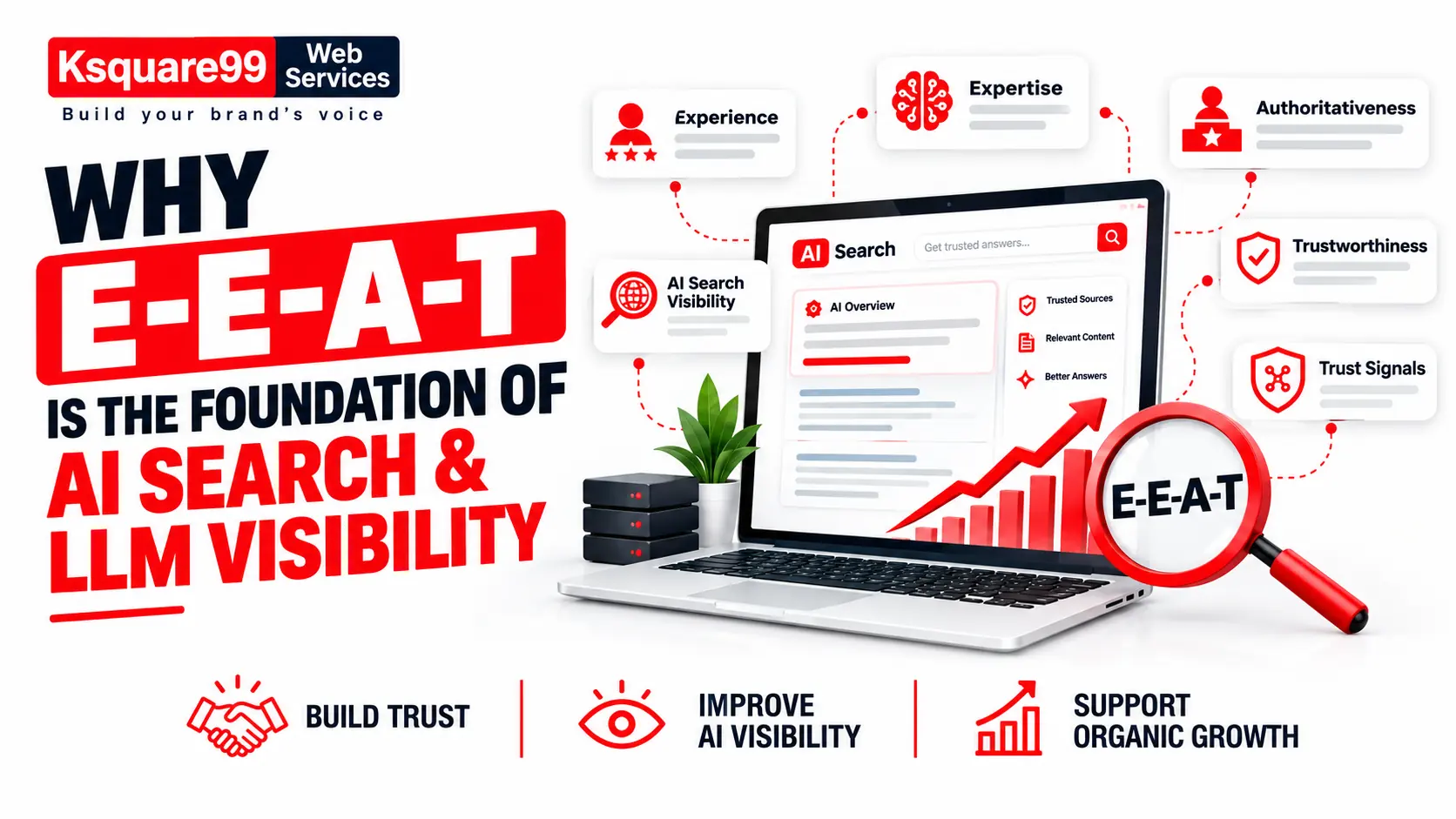
How E-E-A-T Builds Trust in AI Search and LLM Results
E-E-A-T helps AI search engines identify reliable content by emphasizing real experience, expertise, authority, and trust, improving credibility and visibility across AI platforms.
E-E-A-T (Experience, Expertise, Authoritativeness, and Trustworthiness) plays a key role in building online credibility and improving visibility across AI search optimization and large language models (LLMs). AI platforms increasingly rely on clear, reliable, and helpful information to generate relevant answers for users. Websites that demonstrate real-world experience, accurate information, expert knowledge, and trustworthy sources are more likely to be referenced in AI-generated responses. By focusing on high-quality content, transparent authorship, credible sources, and a positive user experience, businesses can strengthen their online reputation and build lasting trust with both search engines and AI-powered platforms.
AI Search Prioritises Trusted Sources
In classic Google search, being number six on page one still got you some clicks. In AI search, there is no number six. There's the answer, and a small set of sources the AI chose to lean on.
That changes the game completely. AI tools don't just match keywords. They pull information from many pages, compare it, and then build one reply. Along the way, they quietly filter out anything that looks thin, outdated, anonymous or unreliable.
Think of it like asking a well-read friend for advice. They won't quote a random forum post they half remember. They'll quote the doctor, the published guide, the company everyone in the industry knows.
That filter is basically E-E-A-T at work. Pages that show who wrote them, where the facts came from, and why the business is qualified to talk about the topic are far more likely to make the cut.
What this means for you: ranking is still useful, because many AI tools pull from search results first. But ranking alone no longer guarantees you a mention. Trust does. That is exactly the gap that Generative Engine Optimization (GEO) is built to close.
Experience Matters More Than Ever
Here's an uncomfortable truth. AI can now write a decent "10 tips" article in seconds. So the internet is flooded with near-identical content. When everyone says the same thing, the AI has no reason to quote any one of them.
What it can't copy is your experience. The things you only know because you did the work.
Compare these two lines:
- Local SEO helps clinics get more patients.
- When we audit clinic websites, we often find more enquiries coming from Google Maps calls than from website forms, so we usually fix the Business Profile first.
The first sentence exists on a thousand websites. The second one only exists on yours. That is what makes it worth citing.
Ways to show real experience in your content:
- Share what you saw, not just what you know. Mention the problem, what you tried, and what happened.
- Use your own photos, screenshots and data. Stock images and borrowed charts add nothing new.
- Admit what didn't work. Real practitioners have failures. Generic content never does.
- Add a short "from our desk" note in long guides where a team member explains how they handle this in practice.
One caution: never invent case studies or numbers to look experienced. AI systems cross-check facts, and so do your customers. A made-up claim can hurt trust far more than a missing one.
Expertise Builds Topical Authority
Experience is about having done the thing. Expertise is about knowing the subject deeply, and proving it again and again.
One great blog post won't make you an expert in the eyes of an AI. A body of work will. When a website covers a topic from many angles, and every page links sensibly to the next, AI systems start to connect that brand with that subject. That connection is what we call topical authority.
Here's how to build it without wasting effort:
- Pick your core topics and stay in your lane. A pest control company should own termites, bed bugs and home safety. Not celebrity news.
- Build content clusters. Create one main guide (the pillar), then support it with smaller posts that answer specific questions. Link them all together.
- Put a real name on every article. Add an author bio with role, years in the field and a link to a proper profile page, like our team page.
- Keep it fresh. Update older posts when facts, prices or tools change. Show the "last updated" date clearly.
- Go deeper than the top results. If every competitor stops at "what is it", explain how to do it, what it costs and what usually goes wrong.
This is the heart of a solid content marketing strategy. It also explains why we treat LLM SEO as a long game. You are teaching the machines what your brand stands for, one useful page at a time.
Trustworthiness Is the Core Signal
If you remember only one part of this blog, make it this one. Google's own guidelines say trust is the most important member of the E-E-A-T family. Experience, expertise and authority all exist to support it.
AI models think the same way. If a source looks risky, the AI would rather leave it out than repeat something wrong. That matters most for topics like health, money, law and safety, where a bad answer can actually hurt someone.
So what makes a website look trustworthy? Here's a simple checklist we use:
| Trust signal | What to check on your site |
| Clear identity | Real company name, address, phone and email on the contact and about pages |
| Named authors | Every article has an author with a bio and relevant credentials |
| Honest sourcing | Facts and figures link to the original study, law or official page |
| Fresh information | Old prices, dates and statistics are updated or removed |
| Site security | HTTPS everywhere, no broken pages, no spammy pop-ups |
| Clear policies | Privacy, refund and terms pages are easy to find |
| Real reviews | Genuine customer reviews on Google and trusted review sites |
Trust is also built away from your website. AI tools read reviews, news mentions, forum threads and directory listings. If people are complaining about you on five platforms, your polished homepage won't save you. This is where online reputation management and AI reputation SEO become part of your search strategy, not a separate job.
AI Visibility Requires Structured Content
You can be the most trusted expert in your field and still get skipped. Why? Because the AI couldn't easily understand your page.
AI tools read content in chunks. They look for a clear question, a clear answer and enough context around it. A wall of text, a vague heading or an answer buried in paragraph nine makes their job harder. And they will happily pick an easier page instead.
Here's what AI-friendly structure looks like in practice:
- Answer first, explain after. Put a short, direct answer right under each heading. Then add the detail.
- Use headings that match real questions. How much does a website audit cost? works better than "Pricing Insights.
- Keep paragraphs short. Two or three sentences each. One idea per paragraph.
- Use lists and tables for steps, comparisons and specs.
- Add an FAQ section to cover the follow-up questions people actually ask.
- Add schema markup. Article, Author, Organization and FAQ schema tell machines exactly what each part of the page is. Our schema markup and entity SEO service handles this end to end.
Structure is also the core idea behind Answer Engine Optimization (AEO). If you want to see where most sites go wrong, read our guide on common mistakes that make websites hard for AI to understand.
Brand Recognition Influences LLM Visibility
LLMs learn from huge amounts of text. Over time, they notice which names keep showing up next to which topics. If your brand is mentioned again and again alongside "AI SEO in India" or "luxury furniture in Delhi", the model starts to treat you as a known player in that space.
The opposite is also true. If nobody outside your own website talks about you, the AI has very little to go on. To a machine, a brand with zero outside mentions looks a lot like a brand that doesn't exist.
This is why brand building and SEO are no longer separate departments. A few things that make a real difference:
- Earn mentions on trusted sites. Industry publications, local news, guest articles and podcasts all count. Our AI PR and mention building work focuses on exactly this.
- Keep your details consistent. Same business name, address and description on Google, LinkedIn, directories and review sites.
- Get listed where your buyers look. Niche directories, comparison sites and association pages are often read by AI tools.
- Show up in conversations. Thoughtful answers on Reddit, Quora or industry forums, written by a real team member, help AI tools link your brand to the topic.
- Build citations, not just backlinks. A plain mention of your brand on a respected page can matter even without a link. That's the idea behind AI citation building.
In simple words: the more the right people talk about you, the easier it becomes for AI to recommend you.
The Future of Search Will Reward Credibility
Search has always rewarded something. In the early days, it was keyword stuffing. Then it was backlinks in bulk. Each shortcut worked for a while, and then it stopped.
AI search is different because the shortcuts are disappearing fast. You can't easily trick a system that reads the whole web, compares sources and checks whether your claims hold up. What it rewards is simple to say and hard to fake: being genuinely credible.
That's actually good news for honest businesses. You don't need the biggest budget. You need to:
- Write from real experience
- Show who is behind your content
- Keep your facts accurate and up to date
- Build a reputation that exists beyond your own website
- Structure your pages so both people and machines can read them easily
Do these well, and you improve your chances in Google, AI Overviews, ChatGPT, Gemini and Perplexity at the same time. One effort, many platforms.
Not sure where your brand stands?
At Ksquare99, we've spent over 12 years helping businesses grow through search. Today, a big part of that work is making brands visible inside AI answers. Our AI SEO audit shows you which E-E-A-T gaps are holding your site back, and what to fix first. Talk to our team and we'll walk you through it.
Frequently Asked Question
What is E-E-A-T in simple words?
E-E-A-T stands for Experience, Expertise, Authoritativeness and Trustworthiness. It's a set of quality signals Google uses to judge whether content is reliable. AI search tools look for very similar signals before they quote a source.
Is E-E-A-T a direct ranking factor?
Not as a single score. Google has said E-E-A-T isn't one ranking factor you can measure. Instead, many smaller signals, like author details, reviews, accurate facts and mentions, add up to show quality.
Why does E-E-A-T matter for ChatGPT, Gemini and Perplexity?
These tools give one combined answer and name only a few sources. They prefer sources that look accurate, expert and trustworthy, so they don't spread wrong information. Strong E-E-A-T makes your content a safer choice to cite.
How long does it take to improve AI search visibility?
Quick fixes like author bios, schema and updated facts can be done in a few weeks. Building real authority and brand mentions takes longer. In our experience, most businesses start seeing steady AI visibility gains in about four to six months.
Can a small business compete with big brands in AI search?
Yes. AI tools often favour specific, experienced answers over general ones. A local clinic or niche manufacturer that writes from real expertise can be cited ahead of a big brand with thin content.